Sunday, November 3, 2013

Ice Queen

Halloween is a time when a mask can be put on and a different persona can be created and lived out.  Whatever costume or personality you can imagine, you can be.  I love being creative and constructing my own costumes on Halloween.  When I was a child I remember how exciting it was to pick out my outfit each year.  One year I was determined to be a cowboy, not a cowgirl but a cowboy.  My mother did not push me to be a cowgirl, but instead allowed me to be whatever I wanted to be that Halloween and in every part of my life.  In the past few years I have not been able to create an outfit because I am usually on the road competing. 

This year I just happened to have some time off to come back to Colorado Springs.  Of course I had to pop back into the Boys and Girls Club and see what the kids came up with for their Halloween costumes.  My favorite costume was a little girl who was a police officer.  She really embraced the identity of a police officer as she cruised through the club saving people and eliminating ‘crime.’  She dutifully made sure everyone waited patiently in line for snack and picked up any trash left behind. For that day she was able to pretend to be something different. 

Just like the young police officer, I morph into a different identity when I am competing.  I put on my costume; my speed suit, bobsled spikes and helmet and become the ‘Ice Queen’.  When I am the Ice Queen I am able to let go of any insecurities or doubt I may have.  I am able to be someone 100 percent confident in my abilities.  The Ice Queen does not care about anything, but pushing the bobsled as fast as she can.  When I am her, I am unbeatable.  Not only does putting on a uniform for a day allow a person to become more confident it also allows them to see what is possible.  Halloween is another opportunity for kids to dream to be something creative, unrealistic or even an Olympic athlete


Monday, October 21, 2013

Boys and Girls Club interview

1.You are an amazing mentor and leader to kids. Did you have a mentor when you were young? If so, who? Did he/she tell you anything that resonates with you to this day?

I am very lucky to have incredible parents.  Both of them have supported me with whatever I have wanted to do and have always pushed for me to create goals.  They have allowed me to dream big and to recognize that I can do or be whatever I want.  I hope this is something I can also instill in the kids at the Boys and Girls Club.  I want them to know that they can do whatever they set their minds on.

2.You're a very busy individual, and time is important to you. How has spending your time at BGCPPR provided value in your life?
My time at the Boys and Girls Club has helped to ground me and remind me that there are much bigger things in life than training and bobsled.  I spend a lot of time focusing on myself and the things I need to do to be a better athlete, so it is nice to step away from that and spend time helping other people.   I leave the club motivated to work harder in my training.  I want the kids to be proud of what I am doing and I want to show them that with hard work anything is possible.

3.You often talk about the need to "dig deep." What does this mean to you? How does one "dig deep"?
Digging deep is pushing yourself beyond the point you ever thought you could go.  For me, that often means pushing my body beyond its physical limitations and finding a way to convince my mind that my body can be pushed to that place.  This can be applied to any aspect of life.  It is about using your mind to dictate what in your life is possible and pushing yourself past any boundaries.    

4.You started your fundraising campaign with $5 from your sister. What advice can you give for those of us looking for support - not only financial - from our family, friends, and/or community?
I have learned that there are people out there that want to help and want to be a part of something that is important.  It is often hard to ask for help, but you will never receive it if you don’t ask.  My community has been incredibly supportive and is something I am thankful for every day.  It is also important to share your success with the people who have supported you.  I really want my community to feel they are as much a part of the Olympic movement as I am.  

5.What has been one of your biggest disappointments as an athlete? What can kids do to better deal with disappointment in life?
I always wanted to be a collegiate athlete and at the time my passion was soccer.   I did everything that I could do to make that soccer team.  I was one of the last people to be cut from the team.  At the time I was devastated, but I learned a lot from that experience and I believe that it happened for a reason.  I learned that once one path is closed it does not mean that you cannot still complete your goal.  I ended up trying out for the track team and had a successful track career.  It is easy to get discouraged when things don’t go the way you want, but there is always another way to make things happen.  I never would have thought I would be an Olympic Bobsledder, but I always wanted to be an Olympian, so I found a way to make it happen.

 6.What is the scariest thing you have had to do? Are you glad you did it?
 In 2006 I went out to Lake Placid, New York and had my first try out of the bobsled team.  I was terrified.  I had not even considered how the actual bobsled ride would be, but was instead scared of making a fool out of myself.  I was going to be face to face with some of the best bobsledders in the world and here I was attempting to insert myself with this elite group of athletes.  I knew if I did not take the risk and go out to the try out I would regret it my entire life.  I am glad I was able to put my fears at bay and complete the try out! 
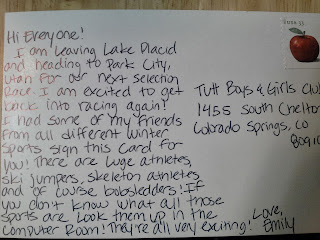

Post Card sent on 10/15/2013!


Sunday, October 6, 2013

Is it worth the cost?

I know many Olympian and Olympic hopefuls that have spent their entire life’s savings and are in significant debt because of the cost of their sport.  This year alone I will have spent thousands of dollars on Ice time, supplements, travel and coaching.  This of course does not include the other unexpected expenses like dental fees or basic vehicle necessity that life will slap you with.  I am one of the luckier athletes.  I may not have dental insurance, but I do have health insurance through the United States Olympic Committee that covers most of my basic health costs and I am fortunate enough to spend my summers training at an Olympic Training Center where my living expenses are covered. 

Not all Olympic hopefuls are as fortunate.  Skeleton Athlete Annie O’Shea just recently turned 26 years old and is now not only faced with paying for her housing to participate in Olympic trials along with her expenses for the season, but is also needing to find a way to cover basic insurance.  Can you imagine sliding head first on ice without health insurance? 

Teammate Katelyn Kelly an upcoming bobsled driver has been in and out of Olympic Training Center housing throughout the summer and has spent countless days staying at a friend’s house and has even been caught in town sleeping in her car.  Both she and Annie have spent their summer waitressing 40 hours a week to pay for necessities to allow them to compete at all this season.  How is an athlete supposed to perform at the highest level when they are not getting adequate training and recovery?
These are just two of the many similar stories of the financial sacrifices made by athletes in hope of earning that elusive spot at the Olympic Games.  As difficult as it may be to shell out the cash each year and how stressful it is to not know where you will sleep it  is comforting to know that each and every day no matter what you do anything you can to get closer to the dream. 

I used to tease my teammates of being frugal, but the reality is we can afford only what we need.  We learn to get scrappy and live on very little means.  I love this sport and that is why I do it.  I have never done it for the pay check or lack thereof.  Katelyn and Annie may have a tougher path because of their financial burden, but like me I hope they think the cost is worth the reward.

Sunday, September 22, 2013

Guest blog by Wendy Azevedo


Olympians Don’t Just Happen, They Are Created

A guest blog by my mom, Wendy Azevedo

I’m terrified of roller coasters and ferris wheels; I hate heights.  I’ve never been on or desired to be a part of an athletic team.  I don’t like to exercise, don’t own any lycra, and my “appreciation” of the great outdoors can be summed up in three words…………..“NOT MY THING.”


How, then, can I truly claim to share a genetic code with a member of the USA Women’s Bobsled team?  Not just any member.  Emily is an Olympian.  She was one of six women that competed in the 2010 winter Olympics in Vancouver, and has been a rank and file member of the USA team for seven years. She scales the tops of mountains only to ride in the back end of what appears to be the gut of a canoe that should be slowly making it’s way down a quiet stream instead of traveling at anywhere from 4-6 g’s at 80-90 mph.

 Having had four daughters who have all been successful in the sporting world, it is not unusual for me to be at a sporting event, or awards ceremony and get asked the question, “So, what sports have you been involved in?”  I try to smile when I say “none,” but the confused look that I get back often makes we wonder if I should have tried to lie instead.  Is it truly possible for an Olympic athlete to come from a home where the only trophies and medals that are displayed are a result of the hard work of the children in the family?

 As an only child, my exposure to the sporting world was limited.  I never experienced the joy of cheering on a sibling at a sporting event or the angst of competing with them to be the best.  Instead, I learned that to truly be the best that I could be, I needed to compete with myself.  And so I did; on a daily basis.

So what do I bring to the table when it comes to creating an Olympian?  I may not have the athletic background, the “sports gene,” or the body structure to contribute to the mix, but to go to the Olympics you must have confidence, believe in yourself, have learned discipline and an understanding that with a strong work ethic and determination you can be anything you want to be.  Combine that with passion and the understanding that if you go to bed at night feeling like you have given your all, you are number one no matter what the scoreboard says.  I gave her that, and she wears it well.


Sunday, September 8, 2013

Never Ever Give Up!

I don’t know Diana Nyad nor had I followed her extreme dream before this her fifth and final attempt of swimming the 110 miles from Cuba to Florida.  I found myself glued to the television cheering the 64 year old on and tearing up as she limped her way up the Florida shore.   Swimming this far in open water is something that I would never have the desire to do, but it was something she dreamed of accomplishing for a solid chunk of her life.  She was determined to never ever give up on this dream.  The mind is a very powerful tool.   It is incredible what can be accomplished when you convince your mind the impossible is possible.  Diana had the courage and will to try and do something that many would say is super human.  There was not another athlete entered in her race but she was in her own race against her own body, fighting to complete the difficult swim before her body was fully depleted and shut down.   She convinced her mind that this was a task that she would be able to perform.

I can 100 percent relate to Diana Nyad and her message of never giving up.  Even after four previous failures and many doubters she believed deep in her heart that this was something she was going to accomplish.  This is a woman who never ever stopped believing in her dream.  She achieved her extreme dream.   I too have had what I thought to be an intangible dream.  My dream is not one that has me in the ocean face to face with sharks, but it does have me sliding down an icy track up to 90mph.  I grew up in Chico, California, which is known more for the brewery Sierra Nevada than it is for bobsledders.  Although my path may have been unorthodox I had my own extreme dream of becoming an Olympian.   

Diana Nyad had a major support team behind her not just to make sure she stayed healthy, but to support her and to believe in her dream with her.  In 2006 I left California and headed to New York terrified, but brave enough to chase something some thought impossible.  Before I left my mom gave me a small picture frame with a message on it.  To this day I carry this frame with me, which simply says, “Believe in yourself” and display it at each of our stops.  She had also written a note on the back that said, “I believe in you.”  My support team is just as important as each day of training is.  Diana Nyad would never have been able to accomplish this incredible feat alone.  She had huge team behind her that believed in her maybe more than she even believed in herself.  We cannot achieve the impossible alone, but we can do it.  As Diana Nyad said, “Never, ever give up.”


Sunday, July 28, 2013

My Athlete Life

My life as an athlete has been a small amount of luck, a hell of a lot of hard work and an indefinite amount of sacrifice.  I wish I could say that an Olympic athlete’s life is as glamorous as society would assume, but our jobs are a bit unorthodox and often times leave us with no stability. When I started sliding I never expected this being a ‘career’ choice that was going to make me money, but instead I was lured in my the idea of competing for my country.  After my first season in the sport I had 12 cents in my bank account.  Thanks to the support of my hometown Chico, California I was able to raise money and train full time as an athlete.  This ultimately helped for me to get the training equipment and coaching I needed to make the 2010 Olympic Team.  I remember lying wide awake in bed after walking in the Opening Ceremony of the Olympic Games in 2010.  I felt like a little kid on Christmas morning.   This was the moment I concluded that every single sacrifice was worth it for that one moment.  I knew then that I wanted to work even harder to work towards earning a spot to Sochi, Russia in 2014. 

After the Vancouver Games I have grown physically and mentally and truly learned how to be an elite athlete.  It is equally important to focus on recovery and diet as it is the physical training.  Our sport is measured by hundredths, so maintaining a strict sports medicine regimen, food plan and sleep schedule can be what makes the difference between making an Olympic Team and not.  This routine can be cumbersome and usually takes precedence over nights out with friends and family.  At this point I have to be somewhat selfish so that I can perform at the highest level for each individual training session.  I have felt very fortunate over the years to have friends and family who are very understanding and supportive.  They are willing to be ‘part time friends’ while I go after my Olympic dreams. 

There are no words that can explain what it feels like to have U.S.A written on your back.   To me, every workout, every tear shed and every family event missed is worth it for those few seconds that I push the sled knowing I am not just doing it for myself, but for my entire country.  The dream is what pushes me every single day and is what helps me to make the hard decision to put my life on hold.  I now truly understand and have lived the concept ‘for the love of the game.’


To buy cool memorabilia or to make a donation to curb training costs check out my website. www.emilyazevedo.com

Sunday, July 14, 2013

Calling all Athletes!

Elite athletes are constantly under a media microscope and are considered role models in the eyes of society regardless if it is something they desire.  In a world where the tragic stories of Aaron Hernandez and Oscar Pistorious are what’s spread over the television or news of the performance enhancing drug scandals of Lance Armstrong, Alex Rodriguez and most recent Tyson Gay are the top stories, it is easy to question if athletes should be considered role models.  So often the media focuses their attention on the negatives of sport rather than the positive.  In a society that places importance on the number of twitter followers rather than performance, I think it is time that athletes step up and take being a role model more seriously.  Obviously, as we have seen all athletes are human and are not immune to making wrong life choices.  Because of this it is even more important for us to reach out to our communities and give kids something positive to emulate.

Many athletes have already worked towards making improvements in their society.  2012 Gold medalist and all around amazing person Tianna Bartoletta has created Club 360 which teaches young girls to live with three core principles; integrity, honor and self-respect.  I can attest to the fact that Tianna lives by the values she is instilling in these young girls and is helping to raise well rounded women.  It is clear that Tianna understands there is more to life than sport and uses her athlete platform wisely as an avenue to inspire and change the world one girl at a time.  Not only has she encouraged young girls to make improvements in their lives, she has also inspired me with her contagious passion for what she is doing. 
Tianna with girls from Club360
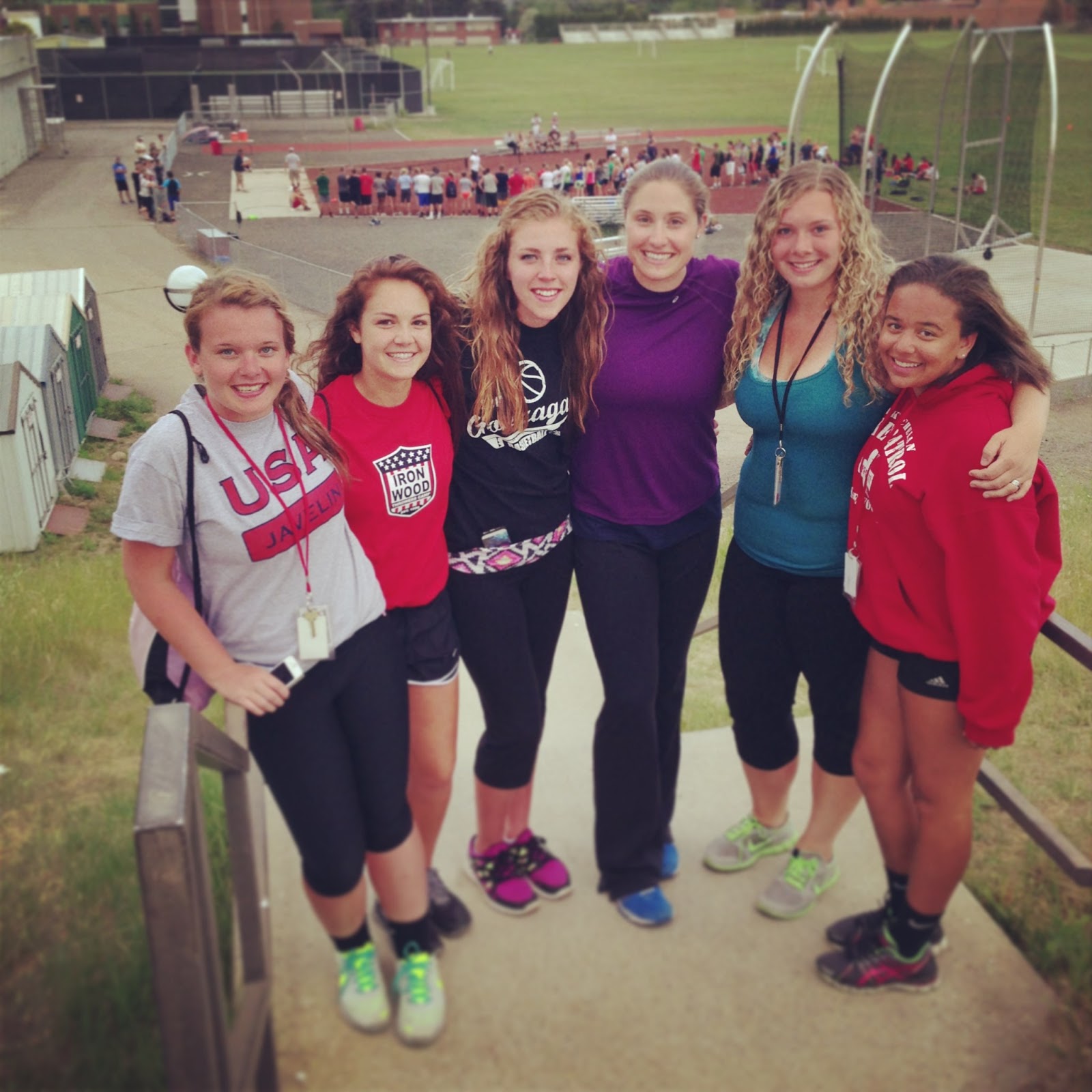
Tianna is just one example of many athletes who have already taken issues into their own hands.  KaraPatterson 2-time Olympian and American Record holder just recently selflessly took time away from knee rehab and training to spend countless hours coaching future Olympic throwers at the Iron Wood Camp.  She was not alone, alongside of her were many Olympians and World Team members sharing their passion for throwing with hundreds of young impressionable kids. 
Kara with IronWoodCamp Campers!

I have also witnessed the incredible change and impact athletes can have on youth in our communities with the Pen Pal Project my teammate Jamie Greubel and I have been running.  This program connected the Boys and Girls Club kids with athletes at the Olympic Training Center.  By writing a simple letter each week the athletes have given the kids someone positive that they can look up to and draw inspiration from for their futures.  The athletes have given these kids an outlet to express any issues they have in their lives and have given them an opportunity to have fun and just be kids.  It was refreshing to see the smiles on each and every one of the kids faces as they met their pen pals for lunch this past Friday.
Kids from the Boys & Girls Club  at the OTC

No matter if it is something as small as writing a letter or as time consuming as week at camp, athletes can make a huge impact with any community involvement they have.  Whenever athletes have an opportunity to touch a life regardless of what avenue it is they should take full advantage of it.  We are looked up to whether we like it or not so let’s choose the positive legacy we want to leave.